
Decision lens
Before using a factory lead time in a project plan, establish whether the order has the information foundation to become export-ready.
When overseas buyers request a quotation for permanent magnets from China, the answer can sound reassuringly clear: four weeks for production, plus seven days by air.
But for magnet rings, tiles, or magnetic assemblies that may require export-control identification, that answer may cover only one part of the order: how long the factory needs to make the product. It does not necessarily answer the more important question: when will this purchase order be ready to be arranged for export, with a complete and supportable compliance file?
Consider a simplified but realistic order scenario. A European actuator manufacturer places an order for high-performance magnet rings for a new project. The PO says “NdFeB magnetic ring.” The technical file gives magnetic performance and dimensions. The end-use statement says “industrial automation.” The supplier quotes a four-week production lead time, and the buyer schedules destination assembly for week six.
After the order is confirmed, the exporter begins item identification. It needs to determine whether the actual material may involve controlled elements, whether the technical description is sufficient to compare the product against the relevant control parameters, and whether the product description, end user, and end-use documents all tell the same story.
At that point, a gap appears. The technical file does not provide the material facts needed for identification, and the declared end use is only a broad industry label. The order has not been “refused for export.” It simply has not yet become a submission-ready, verifiable export file.
That is the detail behind a problem many buyers recognise: production has been scheduled, but the real export lead time has not actually started.
1. A Product Quotation Is Not Yet an Export-Ready Order
“Magnet ring,” “high-performance NdFeB,” or even a magnetic-grade reference may be enough for commercial discussions. It may not be enough for item identification.
For certain permanent-magnet materials, the exporter must compare the actual product with the applicable controlled scope. China's official guidance distinguishes, for example, samarium-cobalt permanent-magnet materials and terbium- or dysprosium-containing NdFeB permanent-magnet materials that have undergone simple processing into products such as pieces, tiles, rings, and related magnetic assemblies. These may fall within the controlled scope. More deeply processed electronic components, such as motors, are treated differently in that specific guidance.
The procurement distinction is important. The buyer's specification usually says, “This is the performance I need.” The exporter still needs to establish, “What is this batch actually made of, and in what product state will it be exported?”
If that second question cannot be supported with usable information, the factory may be able to start production, while the export side cannot yet make a dependable delivery commitment.
2. The Delay Is Often Not the Licence Itself, but the Documents Not Matching Each Other
Where an order requires a licence application, the technical description is only one part of the file. The commercial agreement, product specification or test information, end-user and end-use evidence, and information about the importer and ultimate user all need to relate to the same transaction.
In the example above, “industrial automation” is not, by itself, a sufficiently specific end-use explanation. It does not explain which product will contain the magnet rings, who will use that product, or why the stated specification and quantity fit the declared application. Likewise, if the contract names a distributor but the end-user documentation does not identify the actual user, the exporter cannot treat the order as ready for submission.
This explains a situation that buyers sometimes misread. When a supplier says, “We are still confirming,” it does not necessarily mean the factory is delaying production, or that a licence will necessarily be difficult to obtain. More often, the product facts, commercial documents, and end-use statement have not yet formed one reviewable chain of evidence.
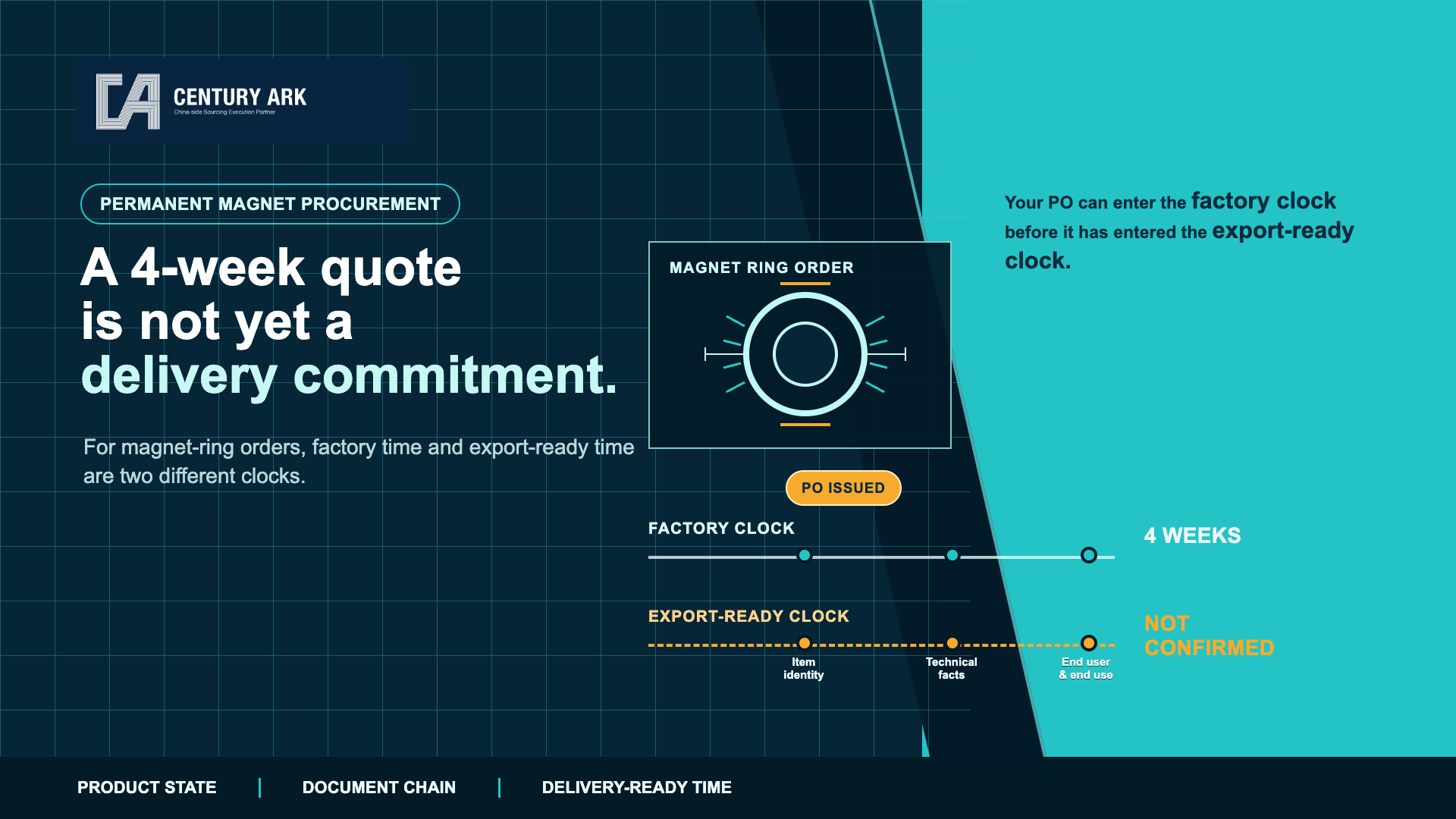
3. Manage Two Clocks: Production Time and Delivery-Ready Time
For this type of order, buyers should manage two separate clocks:
Factory production time: the time needed for materials, processing, inspection, and packing.
Export-order readiness time: the time needed for item identification, completion of technical information, verification of end-user and end-use documents, and, where applicable, the licence process.
If a quotation commits only to the first clock, it is not yet a complete arrival commitment. Before issuing the PO, a buyer will get more value from asking three operational questions than from asking only, “Do you have an export licence?”
Check 1: Has this specific product been preliminarily identified based on its actual material composition and the product state in which it will be exported?
Check 2: What technical, end-user, and end-use information does the exporter need from us before the order can enter export-readiness preparation?
Check 3: Is the quoted lead time factory production time only, or a delivery-ready lead time that includes identification and licence-preparation work where relevant?
This is not about changing a product's form to look for a shortcut around the rules. The product should be identified based on its real condition and intended use. For an overseas buyer, the more useful question is simpler: before I put the factory lead time into my project plan, does this order already have the information foundation to become an executable export order?
The difference between a finished motor and an individual magnet ring can make this mechanism easier to see. Under the specific permanent-magnet guidance cited above, they may be treated differently. But the practical issue for a buyer is not merely where that boundary sits. It is whether the product, documents, and responsibility chain are complete before the PO becomes critical to the project schedule.
This article is a procurement-readiness perspective, not legal, customs, or export-control advice. Product classification and licensing requirements depend on the actual product, transaction structure, applicable rules, and the competent authorities' assessment.
Need to frame the export-readiness question before the next commitment?
Start with the product, documents, and project decision that need a clearer boundary.
Request a review